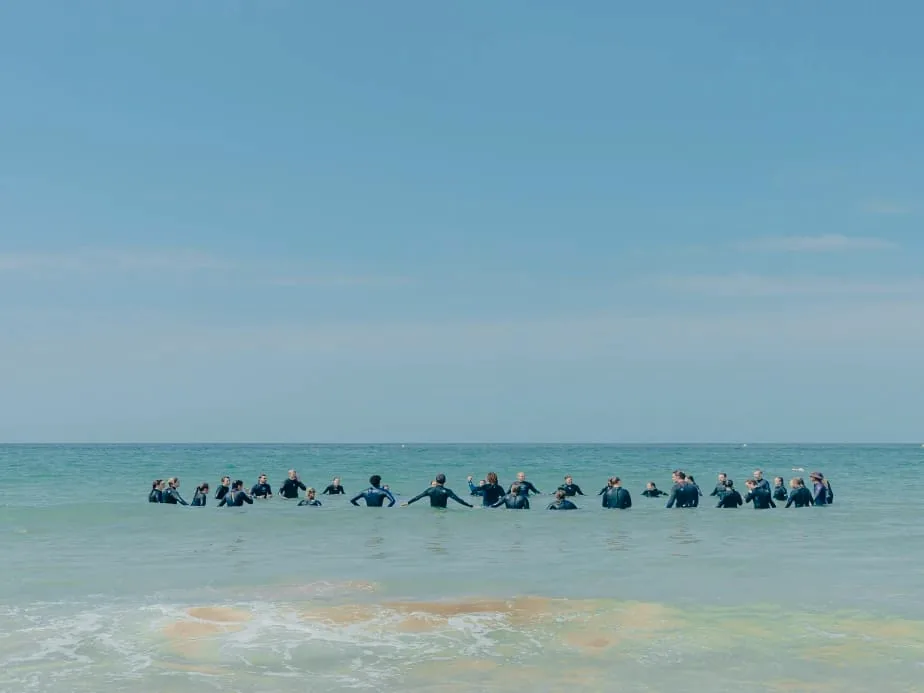
Imourane and Devil’s Rock family progression logic
Imourane / Devil’s Rock is one of the easiest places to explain to mixed groups because it combines beach access, surf-school practicality and a softer progression story than the famous points.
Drive from AGA50–60 min, about 55 km
Distance to Tamraght2 km, 5 min; walkable in 20–25 min
AccessSand entry, wide at low tide, no rock scramble
Level rangeFirst lesson to early intermediate
Trip length3 or 5 nights
The bay, plainly described
Devil's Rock — Imourane on some maps — is the wide sandy bay between Tamraght and Aourir, named for the dark rock outcrop that sits at its southern end. It is not a famous wave and it never will be. What it has is a long stretch of sand, an outside bank that breaks in most swells, an inside that reforms into gentle whitewater, and enough width that four schools can operate at once without anyone getting run over. For a family or a mixed-ability group, that combination is worth more than wave quality.
Why access matters more than the wave
Almost every other setup on this coast starts with a scramble over boulders in booties, timed between sets, carrying a board. At Devil's Rock you walk down a sand path and into the water. That single difference decides whether a nervous first-timer, a nine-year-old or someone coming back from a shoulder injury has a good week or spends it watching. Getting in and out safely is 80% of a beginner's confidence, and it is the part of surfing that photographs badly and gets left out of the marketing.
What the wave actually does
On a small to moderate swell the outside bank produces a soft, sloping wave that breaks and then reforms twice on the way in. Beginners work the inside reform, which is waist to chest high whitewater with a sand bottom and no rocks. Improvers sit further out and take the unbroken wave, which will give a short, mellow right or left depending on the bank. At around 2 m and above the bay closes out and the whole thing becomes a washing machine; that is a day for the points, not for a lesson.
Running a mixed-ability group here
This is the setup for a group where one person surfs well, two have had a lesson and one has never stood up. The strong surfer works the outside, the improvers take the middle, the beginner is in waist-deep water thirty metres from the beach, and everyone can see each other. Add a non-surfer on the sand with a book and the whole party is in the same place at the same time. Trying to do that at Anchor Point ends with three people sitting in a car.
Tide and wind, in practical terms
Low tide widens the beach and moves the break further out, which makes for a long paddle but a cleaner wave. High tide brings it close in and can make the inside surge and dump, which is uncomfortable for beginners. The most useful window is the two hours either side of mid tide on a rising push. Wind follows the usual coastal pattern here: light in the morning, north-west onshore from late morning, which turns the bay into chop by early afternoon. Book lessons for 09:00, not 14:00.
Schools, boards and costs
Several schools run out of Tamraght and Aourir and use this bay as their default classroom. A group lesson with board and wetsuit is typically 250–350 MAD for two hours, a private lesson 500–700, and a week of board and wetsuit hire around 600–900 MAD. Soft-tops are what you want for the first three or four sessions — a hard board at this stage adds bruises and nothing else. Most schools will move you to a large hard board once you are standing consistently on the reform.
What families should know before booking
There is no lifeguard service on this beach, and no beach club. Bring water and shade — there is very little natural cover and the wind makes the sun feel weaker than it is. The nearest cafés and shops are in Tamraght, five minutes by car. Rip currents are present but modest at normal sizes; the standard advice applies, which is to stay between the school's flags or within a hundred metres of your instructor and to swim parallel to the beach if you feel pulled out.
When to move on from here
The signal that you have outgrown this bay is that you are catching unbroken waves on the outside consistently and turning off the bottom. At that point Banana Point and Crocro, ten minutes north, become the right classroom, and the Taghazout points open up in another season or two of surfing. Most people take a week here and a week at Banana before Panorama makes sense. There is no prize for skipping ahead — the rocks at Anchor do not care how enthusiastic you are.
Questions about this route
What age can children start here?
Schools generally take children from about 7 or 8 on a soft-top in the inside reform, provided they are comfortable swimmers. Below that, it becomes beach time with the odd push into whitewater rather than a lesson.
Is Devil's Rock the same thing as Imourane?
Effectively yes — the bay is signed and mapped under both names, and locally the terms are used interchangeably. Imourane sometimes refers specifically to the northern part of the bay.
Do I need a car to surf here?
No, if you stay in Tamraght or Aourir. It is a 20–25 minute walk or a 5–10 MAD shared taxi. From Taghazout it is a 10-minute drive, which is fine but you would not walk it with a board.
What size swell makes it too big?
Around 2 m and above the bay starts closing out and the inside gets heavy. At that point the pointbreaks north are working properly and the schools will move their lessons rather than push through it.